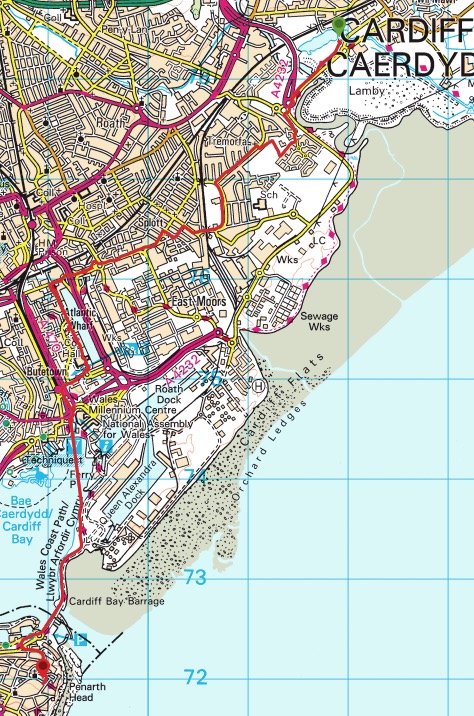
Day 131 – Kidwelly to Carmarthen 14.5 miles 1679′ ascent

Tuesday 14th September 2021

Today was the last day of this walking session and, having put in some extra miles over the last couple of days, we will complete the walk today and not have to put in half a day’s walk tomorrow.

We returned to Kidwelly and parked down at the old quay where the canal met the river. We walked back up into Kidwelly and crossed the river via the road bridge. The official route is then on the road for half a mile before taking an inland route over a couple hills and then dropping down to the River Towy at Ferryside. The alternative would be to walk along the road.

Looking over Gwendraeth to Pembrey Forest

Having walked the first half mile we decided that the hedges were sufficiently overgrown and the vehicles sufficiently frequent that walking along the road to save the hilly inland detour was not entirely to be recommended. We took the uphill route and for the most part it was quite straightforward.  We had a minor issue with a field that was densely planted with maize which in September had reached full height and was fit for harvesting. The farmer had planted across the footpath. Being fully grown we could not see the other side of the field and so we followed other footprints along the field margin but the margin was very narrow and overgrown with nettles. In the end I found that walking between the rows of maize was quite possible especially when holding my poles up to deflect the leaves.

Amazing space

We  came into Ferryside which is a bit of a ribbon development along side the river. We asked a local about finding a coffee stop but the community centre they recommended as our best bet turned out to be shut. During our brief conversation we mentioned the path signs being torn down and he commented that “The Welsh are the most unwelcoming race on earth – and that is coming from a Welshman”. We had our flasks of coffee on a bench instead. Sadly the eponymous ferry no longer operates though it is thought that next year it will start running once more.

Walking down into Ferryside
Ferryside but no ferry

From Ferryside we had to walk up the R. Towy to Carmarthen but the route is never very near the river and was mostly along tarmac in one form or another.

River Towy and Carmarthen

We did cross a few fields and one very dark coomb but much of the walk was along narrow roads between high hedges and lacked views or interest.

Near the village of Croesyceiliog we were surprised to find a small bench on the grass verge by a minor junction; it came as a pleasant surprise as it didn’t feel much like bench territory but we were very happy to sit down on it for our lunch.

The final 3 miles were just a tarmac walk into the town.

New footbridge in Carmarthen

I decided we should reward ourselves with some tea and cream scones if possible. The only places open seemed to be a Costas and a Café Nero. Neither of these were quite what we had in mind as a nice tea stop, preferring to find a local tearoom with a proper pot of tea and a selection of cakes. Sadly, as we have found so often before, all the independent coffee shops and tearooms seem to close very early in the afternoon; long before teatime. So thoroughly disappointed, we returned to the bus station for the bus back to Kidwelly and then drove back to Swansea. Andy and Sue had been expecting a busy day so we all enjoyed fish and chips for supper before packing up ready for our departure back to Yorkshire tomorrow morning. It had been really good to do this leg of the walk from such a comfortable base and have the benefit of Andy’s generous taxi service.

Day 130 – Bynea to Kidwelly 21 miles

Monday 13th September 2021

Today’s walk was originally going to be about 13 miles but having walked 2 miles of it last night we have reduced it to about 10.5 miles so we will try and walk into Kidwelly which is an additional 10 miles. The reason being that once we get into Pembrey Country Park have to walk at least 5 miles to get out of it again. If we can do this it means that we can complete our walk into Carmarthen tomorrow and not have to finish off the last 6.5 miles before driving back to Yorkshire on Wednesday.

Wales Wetland Centre

From Bynae we followed a cycle path through the Wales Wetland Centre. The path was mainly tarmac and the views were a bit limited. We then  came around to Llanelli and the old dock where, in one of the docks, people were out on paddle boards. There is a café/bistro/bar called St Elli’s where we got coffee and cake. It is said that Llanelli is named after St Elli. A helpful waiter told us a little about the history of the area.

Lllanelli Beach

Back on the coast path, we followed along the promenade which is all part of a Millennium park and essentially a regeneration project of the industrial coast area. We called in at the Pavilion Café and got a couple of take-out baguettes made up for lunch.

Burry Port Lighthouse
Burry Port marina

Carrying on along the path we came to the harbour at Burry Port which is now just a marina but also has the lifeboat station. It was about noon and this would have been the end our day’s walk but we were pressing on to do about nine miles of tomorrow’s route.

Pembrey Burrows

We continued into Pembrey Country Park. Since it was lunch time we walked up to the top of the dry ski slope and sat on a bench there and enjoyed the view whilst eating lunch.

Cycle friendly Pembrey Country Park

From the, not very high, dry ski slope we walked back to the coast and on to the beach. The tide had dropped considerably and there was a wide expanse of firm sand to walk along and we had a couple of miles to do. There hundreds of huge jelly fish washed up in a single line for several hundred yards.

Barrel jelly fish
A wreck on Pembrey Sands

There was  a handful of dog walkers but it felt as if we had the beach to ourselves. There were two or three old shipwrecks embedded in the sand. We kept an eye out for the exit route from the beach because the low sand cliff would have been impossible to scale and there were no exit points once we had left the main park area. Fortunately, just where I expected to find it, there was a gap in the sand cliff where a path broke through.

It led to a mainly concrete path through the Pembrey Forest. The path was rather hemmed in by the woods and the concrete was unforgiving for the feet. When we emerged from the woods we walked around the airfield. The whole Pembrey Forest site was a munitions factory in both WW1 & 2 and was only finally closed in 1965. There is much more information about the site on their website.

Before we reached the road we were faced with a path through a field with this impressive bull on guard. The narrow channel of water between him and us didn’t feel like a very effective barrier should he have decided to pursue us. We moved quietly and swiftly to the gate.

Not all the Welsh are welcoming

Wehave been impressed with how well marked the Wales Coast Path is with direction signs in nearly all the necessary locations. Sadly, some people don’t welcome walkers and we have come across a number of places where the Wales Coast Path signs have been broken off.

But not today.

Once we reached the road we had less than two miles to go to Kidwelly. We would have been delighted to see otters crossing but instead we just tramped on into Kidwelly arriving at about 4.30pm having walked nearly 21 miles. Andy soon arrived to pick us up and return us to our car at Bynea.

Day 129 – Llanmadoc to Bynea 20.2 miles 1478′ ascent

Sunday 12th September 2021

We drove to Bynea and left our car there and then Andy drove us plus his dog, Cerys, to Llanmadoc where we finished yesterday.

We walked back up the track to where the path runs down Whitesands and we walked right up to the tip before turning about 300 degrees to walk back up the other side of the spit.

A barrel jelly fish (Lens cap for scale – not swallowed by the jelly fish)
Cliff, Andy & Cerys
Oystercatchers on a disappearing sand bank

Off the tip of Whitesand Point is a disused Victorian cast iron lighthouse. At low water one can walk out to it.

Approaching Whitesand Point
Whitesand Point Lighthouse
Whitesand Point and lighthouse
Andy and his sister – oh, and the dog, Cerys

It was a pleasant walk, made all the more enjoyable by the company of Andy and Cerys.

There used to be a causeway across Cwm Ivy Marsh but it was breached some years ago and has yet to be restored. We walked back up into Cwm Ivy taking the diverted path.

Cwm Ivy marsh and the breach in the causeway

Not far along the diverted path we came to a decision point. There is a low tide route and a high tide route. It seemed worth a quick look at the low water path but though  the channel is not wide, the stepping stones were at least 18” under water.

The low water route was definitely under water.

We returned to the high water route which involved walking up to the road just about a mile along from Llanmadoc. Fortunately it took us past the Britannia Inn where we had coffee and we also managed to get a couple of baguettes to take out for lunch.

Cheriton Church

We walked along the road for a mile before turning down along a very overgrown path to the edge of the salt marsh again. The path was mainly grass or moist mud and was predominantly along field edges before joining the road at Llanrhydian. The next few miles were  a bit tedious being along tarmac next to the salt marsh. We stopped at a large flat stone and sat on it whilst we had our lunch. Lunch done we carried on along the road to where the route skirts around the outside of Crofty and there were lots of ponies were grazing on the marshes.

After Crofty we were on road virtually all the way to Bynea. Fortunately for some of the way there was a cycle path which kept us a little way from the traffic on the road. We had some views of the salt marsh but we were too far away to see many birds.

We eventually joined the A484 to cross the river into Carmarthenshire. After the enjoyable start with Andy and Cerys, the remainder of the day had lacked any real interest and became a fairly tedious, long tramp to the car.

Day 128 – Oxwich to Llanmadoc 19.2 miles 2668’ascent

Saturday 11th September 2021

The weather forecast was for a slightly grey day but fortunately the forecast was overly pessimistic. We drove to Llanmadoc and left our car in the car park there and then Andy drove us on to Oxwich which is only about 6 miles by road but would be 19 miles around the coast. It was dry with 100% cloud cover when we started walking but within minutes the high cloud started to break up. We were treated to a day of sunshine with occasional clouds and a pleasant light breeze.

Oxwich Bay with the tide in.

From Oxwich the path winds through woodland emerging at Oxwich Point where there were good views of the sea and cliffs – a taste of what was to follow.

Oxwich Point
Holy’s Wash

Near Slade there was a diversion because the path had fallen on to the beach but someone had secured a rope to a couple of fence posts to enable those determined enough to get down to the beach to avoid the diversion. We were not that bold.

The path continued along the cliff tops until Horton Bay where we got on to the sand and walked most of the bay but turned up to the promenade to buy something for lunch and have coffee and chips for elevenses at one of the two chip shops on the promenade. It was nice to have a proper coffee stop and we chatted to a couple of lady walkers there who asked us about our walk and tried to persuade us to include the coast of Anglesey as it is so attractive. Anglesey is included as part of the official Welsh Coast Path but is nonetheless an island and we have chosen not to include islands unless, like Mersea, they provide a useful link along the coast.

Port Eynon Bay

From there on the path was just a delight. It followed along the cliff tops dipping occasionally to cross cwms. The air was beautifully clear and we could see across to Lundy.  The cliffs are really impressive and craggy even though they may not be that high. 

Overton Cliffs
Foxhole Slade

There were lots of people out walking and we met a couple of chaps, one of which was walking the Wales Coast Path for a children’s hospice charity.

Charity Walker
The Knave

As Worms Head came into view we looked for somewhere to sit for lunch and spotted a deserted, grassy hollow with an exposed seam of rock ideal for sitting on. Unfortunately, no sooner had we got out our lunch and coffee flasks than a lot of the walkers chose to divert from the main path behind us and detour right in front of our lunch spot.

Worms Head
Worms Head has a natural arch

Worms Head is impressive; it is a tidal island with a natural sea arch (Devil’s Bridge) connecting the far end with the main section. The tide by now had gone out far enough for dozens of people to be streaming across the rocky causeway and on to Worms Head. We walked along the headland back to the village of Rhosilli which, on the map, looks like a handful of houses but I think in reality most of the buildings are cafés or pubs.

It is very popular with tourists

At Rhossili we got on to the sands and walked the length of the beach to the tidal island of Burry Holm.

Rhossili Sands
Rhossili Sands and Worms Head

Then we turned the corner and walked along Broughton Bay to Whiteford Sands. There we had to find the path through the dunes back to Cwm Ivy; that was a bit of a challenge. I climbed on to one of the higher dunes but could not see the actual coast path that was less than 500 m away. In the end we had to retrace our steps along the beach to use an unmarked walkable path we had noted earlier which was obviously popular with dog walkers. We were very pleased to get back to the car after what had become a very tiring day.

Jill on Whiteford Sands

Day 127 – Swansea to Oxwich 20.1 miles 2590′ ascent

Friday 10th September 2021

Andy dropped us off at the Park and Ride in Swansea to resume our walk.

We followed the way-markers down to the Prince of Wales Dock. This dock was devoid of yachts though just as we were leaving the vicinity some chaps were launching several identical dinghies and so I imagine it is used as a sailing school amongst other water sports.

Prince of Wales dock – Swansea

From there we walked across to the Swansea Barrage and crossed the harbour bridge.

Swansea Marina
Swansea Barrage

Then we came to the sea front; the tide was in and it was raining. The water was lapping against the wall of the promenade.

We passed the Swansea Observatory with its statue of Ecliptic on its top.

As we approached Mumbles along the promenade, itself busy with runners and cyclists, we could see the sky was beginning to brighten and the views were getting a little clearer. Mumbles seems like pleasant place and rather nicer than the Swansea sea front so we found a café where we could buy pasties for lunch and stop for a coffee though sadly it was a disappointing choice.

Mumbles
Mumbles lifeboat stations old and new.

Leaving Mumbles the walk changed character completely. We were suddenly back walking on cliffs and climbing up and down and it somehow seemed refreshing especially with the weather definitely brightening up. From Mumbles the scenery was much improved but the path was an over-engineered four foot wide ribbon of concrete for about two miles. Concrete is harder underfoot even than tarmac and we were beginning to crave something more giving to the feet.

A concrete ribbon from Mumbles to Caswell Bay
Jill at Caswell bay

Beyond Caswell Bay the path, to our relief, reverted to an ordinary path and we walked round to Phwlldu Bay.

Phwlldu Bay

At Phwlldu Head there were lots of ripe blackberries which we grazed on as we walked.

On Phwlldu Head

West Cliff and High Tor
Popples Beach, Three Cliffs Beach and Oxwich Bay in the distance

Pennard Burrows is an elevated area of dunes (as high as 50m) behind Popples Bay. It is very sandy but, fortunately for us, there soon was a steep sandy path down to the shore. There we crossed the river via some very substantial stepping stones.

Crossing Pennard Pill

Then we had a short stiff climb up soft sand to the top of Penmaen Burrows which is also about 50m high.

Climbing soft sand up Penmaen Burrows

Since the tide was out we deserted the official coast path which winds its way through Nicholaston and Oxwich Burrows and followed a path to the beach at Little Tor. Now we had an almost uninterrupted walk across damp sand to Oxwich.

Great Tor from Little Tor

Our walk was interrupted by two things. Though we were walking well down the beach toward the low water level, Jill spotted a squirrel running across the sand. It was bounding across the sands until it came to the stream that discharges into the sea across the sands. Though the stream was very wide and shallow close to the sea, the squirrel could not find an acceptable way across. So in the end the squirrel ran all the way back up the beach and disappeared into the dunes.

Squirrel on the beach

We too decided that the stream was too deep to cross without getting wet feet so we walked up to the footbridge just below the dunes.

Oxwich Bay

After that interlude we had less than a mile to walk to Oxwich where we were met by Andy and Sue. 

Day 126 – Porthcawl to Swansea 22 miles 875′ ascent

Thursday 9th September 2021

Andy dropped us back at Rest Bay (Porthcawl) at 8am which gave us a good, early start and him time to get back to join other volunteers of the Swansea Canal Society on their regular Tuesday working party restoring a stretch of the Swansea Canal. The society was awarded the Queen’s Award for Voluntary Service (the MBE for volunteers) in June this year for their work bringing the Swansea Canal back to life for the community through its heritage, wildlife and navigation.

It had been raining hard since early morning and so we had to put on waterproofs before setting off. However, within 10 minutes the rain stopped and the cloud began to thin. 

Initially our path was alongside the golf club and it was good firm turf but as we approached Kenfig Burrows, the path became increasingly sandy. This area of sand dunes had a Norman castle and village once upon a time. With the encroaching sands, the settlements were abandoned. More recently the area became so depopulated that in the C19th it became a “rotten borough”; this was an area with a very small population which nevertheless elected an MP. 

Kenfig Burrows

Halfway along Kenfig burrows we followed the path inland and found that blackberries were ripening nicely beside the path. There also other berries rather similar to blackberries but with silvery bloom. It turns out that these are Dewberries and are also edible.

Dewberries

This path brought us past the much reduced steel works now owned by TATA.

TATA steelworks

There were several sets of railway lines to cross, mostly sidings and marshalling track for the steel works.

The final two tracks were for the mainline and on the far side the fence was adorned with floral tributes to two railway workers who were killed nearby in 2019 by a Paddington to Swansea train. They were working on an open line without adequate lookouts to warn them of an approaching train. The men had started working early before a line closure and they were probably wearing ear defenders. Tragically it was non-essential work. One also has to feel for the driver who applied the emergency brakes and it took nine seconds before the train reached the railway workers.

From here on we were mainly walking alongside motorways or main roads. There was one section where we threaded our way through the suburb of Margam which was a dispiriting experience. There were rows of similar houses with no shops and very few people around. 

Walking along the A4241 was tedious and therefore felt all the more tiring; Jill was keen to have a rest and a coffee if possible. Needless to say we had seen no benches since we left Rest Bay. I wondered if there might be anything near Parkway Station which was almost on route. Having spotted a couple of steel benches outside offices near the station, we discovered a wooden shed next to the station serving flatbreads with various fillings and also coffee. We spent 40 minutes or so sheltering from a rain shower and resting our legs. The Railway Coffee Stop started up four months before Covid19 hit the country but they seem to have survived. They are well worth a visit if you are on the coast path and are open from 8.00 until 2.00. 

Eventually we reached Aberafon beach (the beach of Port Talbot). We walked the length of Aberafon sands on the beach and turned on to the promenade at the north end to use the loos – only to find them locked. Walking the next 1.5 miles with crossed legs was a challenge. We walked through the remains of the built-up area and then started around the outside of Baglan Power Station through the dunes at Whitford Point. After turning the corner, the path became a derelict macadam road through a long-disused industrial area between the power station and the salt marsh. It was a welcome relief in more ways than one.

Pipeline from Baglan Power Station

We followed up the side of the R. Neath and past the site of Brunel’s floating dock which used experimental, buoyant steel lock gates powered by an hydraulic accumulator built by George Armstrong. The tower that housed the hydraulic accumulator remains and has been restored but much of the docks has been lost.

The hydraulic accumulator tower used to power the lock gates.

Then we walked under the M4 and up on to the A48 to cross the R Neath.

M4 bridge over R Neath

We then followed alongside the A48 for a couple of miles before turning north to the Tennant canal. Walking the towpath of the Tennant Canal (which is in private ownership) was at first straightforward but later it was very overgrown.

This brought us to Port Tennant and to the Park and Ride and there we were picked by Andy who arrived just as we did; we were very grateful for the fantastic taxi service he was providing.

Day 125 – Nash Point to Rest Bay (Porthcawl) 16.3 miles 1577′ ascent

Wednesday 8th September 2021

We left Swansea in convoy with Andy and left our car at Rest Bay. Andy then drove us on to Nash Point so we could resume the walk.

Fortunately today was a few degrees cooler than yesterday and there was high cloud.  The walk from Nash Point was very pleasant though one tor two of the stiles were unduly high and constructed from a slab of stone therefore quite difficult to clamber over. It would certainly pose a challenge to the short and/or overweight.

Stiles designed to impede progress rather than to aid it.

The cliffs were the very blocky limestone that we have become familiar with in the area and the tide, though receding was still quite high. There were a couple of coombs or, in Welsh, cwms (I think) to go round but nothing too arduous.

Nash Point

A fence post on the cliff-top barbed wire fence had broken and the cattle had wasted no time in exploring the edge of the cliff and picking up burrs from the long grass and other vegetation.

We came to Dunraven and had coffee at a picnic table before walking down to the walled garden and having a brief look.

The walled garden at Dunraven
Dunraven Bay

The path then followed a nice, cropped-grass cliff top route to Ogmore-by-sea where there were lots of people on the beach and walking out on the now exposed sands.

We debated whether to try wading the river close to the sea but there were lots of signs prohibiting bathing in the river presumably on grounds of safety so we decided to follow the way markers and walk up the river to Ogmore.

C12th Ogmore Castle built by the Norman William de Londres to protect himself from the Welsh.

At Ogmore the river can safely be crossed in two stages by bridges or in our case by stepping stones followed by a bridge. Jill is not a fan of stepping stones and so her anxiety levels were already raised as we approached the stones. A cyclist, having shouldered his bike, was coming across towards us and as he reached the bank remarked “It’s always good to get across there without incident”. That was not what Jill wanted to hear. The stepping stones required a good long stride and there was one that had a rather tilted top but fortunately they were dry.

The stepping stones by Ogmore Castle
The bridge that followed was much more civilised.

We walked into Merthyr Mawr and sat on a bench in the shade to have our lunch. After lunch we had a mile road walk to the Merthyr Mawr car park.

Next we had to negotiate the Merthyr Mawr Warren. This is a very substantial area of sand dunes. I am always nervous of sand dunes because rights of way on the maps have often been superseded by paths made be visitors and dog-walkers and there can be a confusing network of paths. There are sometimes areas of marsh or even little lagoons. I was disappointed, therefore, not to spot a way marker as we entered the warren from the car park. The path on the map showed the route returning to the banks of the R. Ogmore. We started following an obvious path but this became less obvious and veered away from our intended direction. The wonders of satellite navigation came to our aid. In fact we were only a matter of yards away from the intended path which, when we found it, had way markers – not to mention a string of horse-riders exercising horses from a local stable.

The path alongside the R Ogmore

The sand was very dry and it was hard work walking across it. Fortunately there was a damp strip where the tide must come in each day and so that made things a bit easier. When we reached the beach there were miles of exposed sand though we had to walk out some way to find really firm “walking” sand. The beach according to the map is called Traeth yr Afon which I would translate as “The River Beach” so I wonder if it was a misunderstanding on the part of early map makers of what locals told them in Welsh as The River Beach seems an unlikely name.

Traeth yr Afon

We strode down the bay and crossed a low outcrop of rock and then continued along the beach all the way to the holiday park on the edge of Porthcawl. We walked across the headland and then got back on to the sand the other side and walked across Trecco Bay followed by Sandy Bay which took us into Porthcawl.

A little ringed plover
Sea defences – Porthcawl

We were ready for some refreshments and so we stopped for tea at a promenade café for half an hour and relaxed. From there we had a simple walk of 1.5 miles to the car park at Rest Bay.

Day 124 – Barry Docks to Nash Point 19 miles 1820 ‘ ascent

Tuesday 7th September 2021

We had a slight change to our plans today because Andy was quite insistent on helping out by driving us back to Barry Docks and us dropping off our car for the return journey on the way. This was great as it saved us walking into Llantwitt Major (1.5 miles) to get to the station and repeating it the other way tomorrow which meant we could walk on to Nash Point. So that is where we left the car.

The weather forecast for today was hot to extremely hot. Temperatures expected to be in the high 20s and indeed we heard later on the news that the highest UK temperature of 29.5 was recorded not very far away from us in South Wales.

Barry Council building

Andy dropped us near the Park and Ride car park which the station shares with the impressive council building and library – an indicator of the former glory and wealth of South Wales. We left the station, crossed the dual carriageway and soon the path was following down the side of the now-disused Barry Docks.

Breakwaters guarding the entrance to Barry Docks

Even at 09.00 it was hot. From the end of dock we started a loop around Barry Island. It is not a true island but rounded peninsula with a narrow base; on the map it looked as if it might be a pointless walk but it was very enjoyable. Initially we followed around the cliff top and then climbed down onto the beach and walked its length before going round the headland.

Whitmore Bay – Barry Island

As we approached the mainland, we came to Barry Harbour which is nothing to do with Barry Docks. Barry Harbour is an inlet with an area of marshland guarded by a harbour wall. It was the harbour for Barry for hundreds of years but was superseded by Barry Docks. It was used by pleasure craft until the 1990s but it is now silted up. It looked as if we could walk across so we started and then realised there was a watercourse and we didn’t fancy a paddle so we walked round the road. By the time we had walked round the tide had receded further and we could probably have crossed safely.

The harbour wall at Barry Harbour

We left the sandy Barry Beaches and followed around Cold Knapp Point to the next beach which is a beautiful eponymous Pebble Beach. It seemed amazing that in the space of a couple of hundred metres the coast could change quite so dramatically

Pebble Beach – Barry

At the end of Pebble Beach is Polkerry Park with its rail viaduct.

Polkerry Viaduct

We continued around the coast past Rhoose which has Cardiff’s airport though it has hardly any commercial flights; we saw a number of light aircraft and helicopters. Shortly after we went through a restoration project area of a large quarry which had been excavated behind the sea cliffs leaving them rather like a huge breakwater but there was a gap broken through to the beach.

The Aberthaw Power Station
Aberthaw Power Station

Up ahead we could see the old Aberthaw Power Station which is being de-commissioned. The walk around the power station was entirely on concrete sea wall and so it felt very hot from the reflected sunshine.

This sign was not especially reassuring. COMAH stands for Control of Major Accident Hazards.

We couldn’t find any benches in shade or indeed any shade, so we sat hard up to some huge, concrete sea defence blocks which cast a narrow band of shade that we could get into. We had a leisurely lunch cooling off in the shade with our backs pressed against the cool of the concrete blocks.

The only shade we could find for our lunch

After lunch we had a few miles of walking along with a variety of views from the low cliffs. The limestone beaches were wonderful with extensive areas of limestone pavement.

The path descended to the beach at Llantwit Beach and fortunately at just before 4pm the café was still open and so we were able to buy ice creams and cool drinks.

We still had 2.5 miles to go to reach Nash Point. The path resumed following the cliff and dropping down to a very bouldery beach at Tresilian Bay.

Tresilian Bay
An ankle-turning, bouldery beach

At Donat the path descends to pass by the Atlantic College, a private college for the daughters and sons of the wealthy, including Princess Leonor, heir to the Spanish throne and Princess Alexia of the Netherlands. The college is housed in St Donat’s Castle and not surprisingly it has a secure perimeter.

Nash Point Lighthouse

From Donat we climbed back to the cliff top and there we could clearly see the two lighthouses at Nash Point. The nearer, operational, lighthouse was brilliant white in the afternoon sunshine. It must surely have been repainted very recently. The second lighthouse a few hundred feet away is decommissioned but was built at much the same time as other lighthouse so they acted as leading lights for shipping in the Bristol Channel. When it was decommissioned a red sector was added to the light of the working lighthouse to indicate the sandbanks which are the site of former shipwrecks.                   

The decommissioned lighthouse at Nash Point


Day 123 – Penarth to Barry Docks 9 miles 545′ Ascent

Monday 6th September 2021

We started our next walking session today. We drove down to Penarth and parked readily on Clive Place and were on the coast path almost immediately. The air-con in the car was giving us a false sense of what the weather was like because when we got out we almost fell over with the heat. After a cool, damp August we were not expecting temperatures in the high 20s in September.

We quickly came to the sea front at Penarth which is very attractive with an elegant Victorian pier without any tacky, modern adornments; the promenade has hanging baskets of flowers. There were some bikers in town.

Soon we left the promenade and were walking the top of the low cliffs. The views were rather limited because there was thickish sea fog hanging over the Bristol Channel even though it was clear over the land. 

The cliffs near Penarth

Eventually Flatholme with its lighthouse appeared out of the mist, shortly followed by Steep Holme. We passed Sully Island, a tidal island which looked almost like a trio with the other two.

Sully Island with Flatholme to left and Steepholme behind

Shortly after passing Sulley Island, the path turns on to the road and we had tarmac all the way to Barry Docks.

Jill with Sully Isle behind

The road was initially single carriageway until we were walking alongside a dual carriageway down to Barry Docks.

The road to Barry Docks

At Barry Docks we could have caught a train most of the way back to the car but, having just missed a train, we ordered a taxi to take us back to Penarth. We still had nearly an hour’s drive on to Swansea to where Jill’s brother Andy and his wife Sue have invited us to stay with them and their labradors, Anna and Cerys. (Not to mention Thunder, Sue’s bearded dragon.) We will be staying with them for just over a week as we walk through to Carmarthen.

Day 122 – Cardiff to Penarth 6.4 miles 405′ ascent

Tuesday 31st August 2021

Today is the last day of this leg of our walk. We decided it would be good to put in a short walk to get us to the far side of Cardiff in readiness for the next section which will be all the way round to Carmarthen. So today’s walk was just over six miles to Penarth.

We drove the short distance back to the Tredelerch carpark where the coast path actually passes through. Though I had plotted the Wales Coast Path on to my Sat nav we soon discovered that the route on the OS maps has been altered. It would seem that the new route avoids some of the fast roads and dual carriageways on the east of the dock complex. Once again the signing of the path was very good and we found ourselves weaving in and out of side roads and across bits of park land until we came to the Atlantic Wharf.

Road sign installation on a Cardiff roundabout

I had imagined that Atlantic Wharf would be a vibrant even trendy location with cafes with tables along the wharf with the movers and shakers of Cardiff sipping their cappuccinos and lattes. There are several blocks of apartments which look relatively recent and apparently in good order on the west side of the wharf and there is a walkway the entire length but it was deserted. Modern urban decay seems to be setting in with weeds forcing their way up between the block paving and a general scene of desolation. Part of the problem seems to be that the wharf, though of considerable size has no longer has a canal connecting it with Cardiff Bay and so it is not like a marina with boats attracting economic activity. At the end of the wharf we passed the Cardiff County Hall which seemed to be empty, presumably the staff are still working from home. There were two anglers hidden in their little tents as sad and miserable as the homeless. I see from a website that the area is due to be further developed to try and inject some life into it.

Atlantic Wharf

From the Atlantic Wharf It is only about 200 or 300 yards to the Cardiff Bay front where the splendid Millenium hall is sited. Behind it, from our direction of travel, is the Senedd building which would do well to remain hidden. It seems to be an uninspired piece of greying modern architecture. By contrast the the Pier Head building which has been incorporated into the Senedd is a beautiful piece of red brick Victoriana.

The Millenium Centre Cardiff

The Senned

The Cardiff Bay Front was hardly full of life; there were a few dozens of people admiring the sights. An open-air market was setting up but I could hear one stall holder saying to another that she thought it was a waste of time.

We walked past the Norwegian Church, now and arts centre and café, and on down to the Cardiff Bay Barrage; it is not a very interesting walk. We crossed the part of the barrage that goes up and down and the lock gates to let boats through and came to Penarth.

Cardiff Bay Barrage
The Cardiff Bay barrage “works”

It was only a mile or so to the centre of Penarth where we found a Danish Bakery and café where we rewarded ourselves with coffee and pastries whilst waiting for our taxi to take us back to our car. We then drove back to North Yorkshire where we have a break of just six days before we return to Wales.

Design a site like this with WordPress.com
Get started