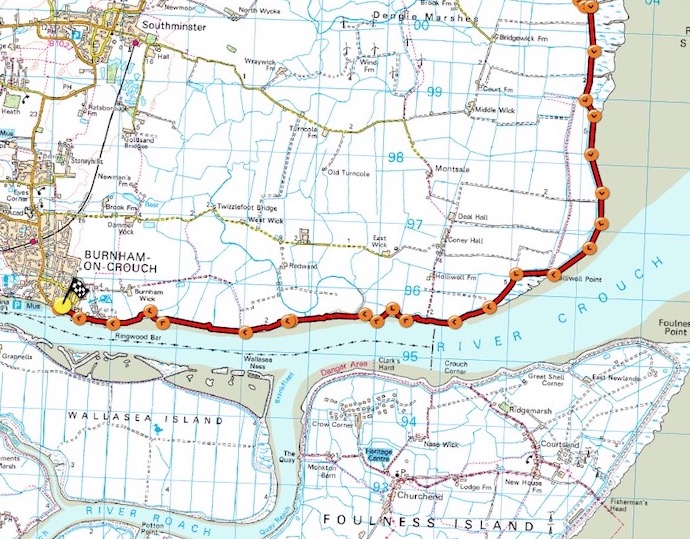
Day 52 – Stoke to Rainham 19.2 miles

Saturday 5th September 2020

As with the last two days the weather was due to be good again today. We left the car at the hotel and took a cab to North Street, Stoke where we finished last night. There was a sycamore tree there which was smothered in seeds. We were walking by soon after 8:30.

We followed footpaths down to the shore of the Medway. Apart from crossing the railway there was also apparently an issue with the Amazon depot at Kingsnorth.

There is an old power station at Kingsnorth which is due to be demolished. (We have an unusual interest in power station stations, gas terminals and off-shore wind farms etc since our daughter is an energy journalist and we send her pictures to test her knowledge).

We followed a broad, grassy seawall for about a mile looking out over Hoo Flats.

Hoo flats
Approaching Port Werburgh

Then the path threaded through a variety of boat yards, sailing clubs and small industrial units. There had a been a big fire in one of the industrial units just 36 hours before and some LPG cylinders had exploded in the heat. Curiously we didn’t notice any smell or see any evidence of the fire though we must have walked within yards of it.

From Port Werburgh to Lower Upnor, the footpath is actually on the shore between the low and high water levels and so is only walkable at low tide. By chance we were there when the tide was only just starting to come in and so we had plenty of time to reach Lower Upnor. The path is quite slippery in places. There were some impressive sections of old brick wall that had been eroded by the sea water.

Upnor Castle looked impressive as we walked along the shore. The path follows a pretty lane down to the castle entrance. It was open but we did not feel we had the time to go round it.

Upnor Castle
The lane to Upnor Castle

There followed another short section of tidal walking before we came to the A289 as it goes through the Medway Tunnel. Pedestrians cannot enter the tunnel and must continue upstream to Rochester Bridge. As we approached the bridge we could see a submarine moored there. This is a Russian Black Widow sub from 1967 which was armed with nuclear missiles. It was sold to a private investor in a sell-off in 1997 and is currently meant to be being restored though there did not seem to be a lot of evidence of that.

Russian sub with Rochester Castle behind

We crossed Rochester Bridge and then walked up the High Street and stopped for coffee and cake. Rochester Castle and Cathedral both looked impressive and some time we must return and look at both of them properly.

High Street Rochester
Rochester Castle
Rochester Cathedral

We followed the High Street out of the smart part of Rochester past some Seamen’s Almhouses and then past Medway County Court and sent Joe a photo to remind of his time appearing there as a barrister.

It would be good to visit Chatham Docks one day, but today they were closed. We did however walk past the Royal School of Military Engineering and the Royal Engineers Museum and glanced at a selection of military mechanised bridge machines parked outside the museum.

We finally got back on to the shore again at the Strand and since it was 1:30 we found a bench and settled down in the sunshine and enjoyed lunch that we had bought in a bakers in Rochester.

Back on the Strand, Gillingham

The afternoon was spent following the shore line of the Medway with good view across to where we had been walking in the morning. The shoreline has an excellent path and indeed most of it is part of a Riverside Country Park.  We had views across to the Isle of Grain that seemed to dominate our view for the next couple of days.

Isle of Grain with Hoo Fort in foreground on the left.
A rotting hull beached on the Medway shore

We were going well, indeed so well that we walked past the point where I had meant to turn off the path and walk into Rainham. Unfortunately that gave us an extra half mile of walking for no real gain. We soon got back to hotel and got in the car and moved five miles down the road to Sittingbourne – just because the Rainham Premier Inn could  only offer us two nights.

It had been a good day’s walking with lots of variety and lots of interest, probably the best day since leaving Suffolk.

Day 51 – Cliffe to North Street, Stoke. 19.1 miles

Friday 4th September 2020

This morning we had a quick breakfast in our room and then got ready to leave for Cliffe where we  finished last night. We had a slightly frustrating journey because the eastbound approach to the Medway Tunnel was closed and the diversion route across Rochester bridge was restricted to a single lane by roadworks .

Despite this we were walking shortly before 9:00. We headed back down the Pickles Way through the Cliffe Pools nature reserve and soon regained the sea wall. The path on the sea wall was narrow on a camber and close to the concrete parapet of the wall and so it was easier to walk along the track which runs parallel with it. This was easy walking but we missed out on the view over the Thames. However, the views inland were not displeasing and, though sea wall and reclaimed land reminded us of Essex, at least the land wasn’t planted with acres of grain. The similarity was hardly surprising since we were just walking down the other side of the Thames Estuary.

Further on when the concrete parapet was discontinued we did get on to the top of the sea wall and were able to watch one or two ships sailing down the Thames, though we were surprised we did not see more. The cranes of the London Gateway Port and the huge container ships seemed very close.

The boundary stone for the Company of Watermen and Lightermen (it has seen better days)

Near Lower Hope Point there is a stone monument, the nature of which was unclear because the inscription is so eroded by weather as to be unintelligible. It was apparently installed in 1982, presumably replacing a previous stone, and it marks the the extent of the jurisdiction of the Company of Watermen and Lightermen of the River Thames who in former times regulated ferrying goods and people across the Thames and out to ships in the Thames. The Company of Watermen and Lightermen of the River Thames was founded in 1514, when the earliest Act of Parliament for regulating watermen, wherrymen and bargemen received Royal Assent from King Henry VIII.

On the landward side there were old buildings left over from when much of the Hoo peninsula was an MOD training camp.

Shortly after this we came to an inland loop at Salt Fleet Flats which I knew about from the on-line aerial photographs but on my digital OS maps, which were probably only ten years old, the path continued on the sea wall. In fact, the sea wall has been intentionally breached as compensation for loss of habitat due to London Gateway Port project on the north bank of the estuary. Oddly, though vehicles were allowed along the top of this section of new sea wall, pedestrians are expressly forbidden. It seemed a bit odd since there were no vehicles there at all.

London Gateway Port

At Egypt Bay we had an option of a short-cut which is not something that happens often on this wall. There appeared to be a new section of sea wall which was quite walkable but just not a right of way. It saved perhaps half a mile which hardly compensates for the extras we have previously walked.

We (that is Jill) always like somewhere comfortable to sit for coffee or lunch preferably a bench but a block of stone or a log will do. As has been the case so often on sea walls there has been nothing in the way of a comfortable sit-upon. It was just the same today until we came near to Dagnam Saltings where some strong people have propped up some driftwood to make excellent makeshift benches. That made a good coffee stop.

After a bit more we could see the holiday village of Allhallows-on-Sea but the sea wall ended and there was just a gentle slope up to agricultural land. The path followed through the Dagnam Saltings and clearly it was not well used. There was a vague line where vegetation had been broken down by perhaps a single walker. There were one or two unofficial plank bridges over narrow creeks but much of the time we were walking on ground that was regularly flooded. With the aid of my GPS, I knew we were on the correct line of the path but it was apparent that a stretch of the path has been lost to the sea. We made our way along the marsh following a rudimentary path and came to a point where we rejoined the right of way shown on the map. At this point we should have been turning towards the sea and walking down to a pill box and then walking along the foreshore to reach the concrete sea wall at Allhallows-on-Sea. I walked down to assess the situation but the tide was already filling a creek that we would need to jump across and then walk along a section of beach. This seemed like a risk too great (particularly for Jill with her slightly dodgy knee) and so we turned inland and crossed a narrow creek that had not yet filled with the incoming tide and got into a field that led to a golf course. When we got round to the sea wall there was a concrete post on the beach saying “Footpath” and another warning sign saying that the footpath was flooded at high tide. High tide was at 15:30 and we were walking though barely 90 minutes before and so we were lucky we got through dry-shod.

We walked on to the grassy promenade and settled on to a real bench to have our lunch.

After lunch we continued along the sea wall for another mile or so, then turned inland. There are some rights of way which continue into the marsh further east but there is no clear way of getting out of the marsh. The rights of way just stop without reaching a road. I did “Street View” the most likely exit off the marsh but there was high gate and barbed wire. I was not committed to walking to Grain because the Isle of Grain is historically, at least, an island. Now much of the south it is taken up with a container terminal, power station and refinery, all inaccessible. Most of the north of the island is a “Danger Area”.

The Isle of Grain

We walked though Allhallows and then along the road to Upper Stoke then Middle Stoke and finally Stoke itself. Since we had a bit of time on out hands we decided to go the extra mile and walk on to North Street.

We eventually got a taxi to take us back to Cliffe. It would seem that the Hoo peninsula is generally too remote for taxi firms in Rochester and Chatham to be bothered with. Fortunately we got a ride because the call handler called us back having discovered they had a car out our way and so they would do a pick up; previously she had had said they could not help.

Having collected our car we drove back to Rainham to the hotel. In the evening we went to a Greek restaurant and had a very good meal.

Day 50 – Gravesend to Cliffe 7.9miles

Thursday 3rd September 2020

We left home at 7:15 and drove to Gravesend, our plan being to get half a day’s walk in following the drive.

Jill waiting for the ferry
The ferry at Tilbury

Fortunately we had a good journey and arrived at Gravesend just before noon and so we were able to get down to the pier and take the ferry to Tilbury and back again a few minutes later. Crossing the Thames seemed like an important landmark on our walk and so we wanted to make the physical crossing back to Tilbury where we finished our last walk around Essex. I was delighted to make use of my senior bus pass for the first time. I had not realised I was entitled to one more than a year ago and so I could have saved quite a lot on bus fares.

Cycle Route 1

Once we were back at Gravesend, we wandered into the town and stopped for a cup of coffee and spiced apple cake. Then we set off along the coast. We passed a sign reminding us that this was also part of the Cycle Route 1 which goes from Inverness to Dover. We would be boxing and coxing with this route over the next few days because its traffic free sections follow sea walls and promenades along which we would be walking.

Container ship – we have seen this one before.

We had a mile or two of semi-industrial coast to get through and then emerged on to the sea wall. Looking across towards Tilbury, Jill noticed this container ship and thought it looked familiar; it is the same one she photographed some three weeks earlier when we were walking around Essex.

It was a really good sea wall; it was quite wide and covered in cropped grass and firm. We enjoyed walking side by side and enjoyed the warm air and sea breeze. On the landward side was an MOD danger area because of a rifle range. I think, historically, most of the Hoo peninsula was used by the MOD.

We passed a herd of ponies grazing on the saltmarsh and sea wall. Most of the mares had young ponies suckling. They were very sweet.

As we approached Cliffe, the path turned seaward to pass around a series of gravel pits, now flooded. The path between the sea on one side and the lakes on the other was quite narrow and, with the tide in, the sea level was considerably higher than that of the lakes. Sadly the foreshore was thick with rubbish, mostly plastic in all colours, shapes and sizes and countries of origin. I was amused by an apparent warning sign; without punctuation it could actually have three different meanings.

Soon we came to Cliffe Fort which was built in the 1860s when attack from France was considered a risk. The fort is unsafe and fenced off and not that spectacular to look at.

Cliffe Fort

After winding around the fort we went through the quarry, properly fenced off but it was interesting to see the conveyor systems close to. There is a jetty so I assume the gravel and sand is loaded directly on to ships and barges for distribution.

Once past the quarry, we walked up between the pools of the Cliffe Pools Nature Reserve. Then we had a short walk into the village of Cliffe.

St Helen’s Church, Cliffe. Rochester
Jill waiting for the taxi at Cliffe

We summoned a taxi and returned to collect our car from Gravesend and drove to Rainham where we were to spend three nights.

Day 49 – Benfleet to Tilbury 21.1 miles

18th August 2020

The last day of this leg of our walk was relatively straightforward (famous last words). We drove to the station car park at Benfleet Station and started to walk following the railway line. This is as close as one can get to the sea. Beyond the sea margin is Canvey Island and you wouldn’t want to get to close to that.

Soon we came to the rather attractive Church of St Margaret, an old “marsh church”. It dates from Saxon times and is recorded in the Domesday Book. It serves the village of Bowers Gifford. Unfortunately it was closed.

Then we walked around Vange Marshes and headed for Fobbing.

Here again official footpath diversions had been set up to divert the path from crossing fields but, as before, the new route was not yet changed on the OS mapping. Convinced we were getting too far off route, we retraced our steps around the edge of one field but could still find no obvious exit. In the end we found one place where we could cross the steep-sided ditch before it became too wide and full of water and could then see we were quite close to Fobbing Church. Jill could see a clear track up the side of a field that, according to the map, would bring us to the village playground and so it seemed like a reasonable option. Needless to say the track turned left into a farmyard where we were probably not welcome, and there was no access into the playground. Fortunately the dry weather meant that we were able to get over some barbed wire and and managed to scramble down into the 5′ deep earth ditch and climb out the other side to reach the playground – where we stopped on a bench and had coffee.

South east of Fobbing and Corringham is the London Gateway Port and that too we had to by-pass. There is only a road in and no other public right of way.  We continued along footpaths to Mucking only to find ourselves approaching a main road that wasn’t on the map. The road to the London Gateway has been upgraded and as a result the footpath has been diverted to a safer crossing point half a mile down the road; footpath signs insisted we turned left. The road was quiet with long, clear view of any approaching lorries so, at Jill’s suggestion, we legged it across the first carriageway, over the crash barrier and across the other carriageway. No harm done!

My plan was to walk through the Thurrock Thameside Nature Park and then pick up the coast path by the jetty at the travelling cranes. There were signs for a Visitor Centre at the Nature Park where we thought we might have a proper lunch break but, having walked three quarters of a mile to get to it, it was closed. Worse still, access to the jetty where the right of way commenced was fenced off. We got through the fence but were faced with the remains of a land-fill site to cross and large dumper-trucks and lorries going up and down the track. The driver of one truck gesticulated to suggest we might be intruding. So we went back through the fence and walked the three quarters of a mile back up to Mucking. From Mucking there is a new path that is not on OS mapping but wends its way around the edge of Mucking Marshes to reach the Thames just over half a mile from where we had originally hoped to reach it.

From there we had a straightforward walk along the sea wall to Coalhouse Fort. As we walked, I had remarked on a helicopter which seemed to be circling around above us. Along the sea wall we met a Thurrock ranger standing by his truck who asked if we had seen an old gentleman wandering around. Apparently an old man with Alzheimer’s disease had gone missing but we couldn’t offer any help.

At Coalport Fort we were pleased to see the café was open so we stopped for a cup of tea and ice creams. Just as we were leaving, a little boy who was playing on the barrel of one of the big guns that had been dismantled, fell off into the nettles. He screamed. Fortunately Jill was there with the sting relief from her little first aid kit. His mum was very grateful.

We set off along the coast path for Tilbury and after only a quarter of a mile came to a barrier with a notice informing us that the the footpath was closed because the sea wall was unsafe. We paused and discussed what to do; there was no diversion route indicated.

An alternative route would have added miles to our day’s walk. Buoyed up by some locals who thought the the closure was nonsense, we decided to press on.

We were glad we did because though the sea wall had collapsed on the landward side it was still quite passable.

We continued on our way. Initially the path was on the top of the wall but later it was on the seaward side and was strewn with debris from high tides.

Fortunately the tide was well out as at high tide the path sometimes becomes submerged which would have meant diverting from a long way back. Shortly before Tilbury dock, a steel staircase took us back over the sea wall and then past Tilbury Fort.

Finally we passed the famous World’s End pub by the dock and could see the Tilbury Ferry. We had hoped to get the Tilbury Ferry to finish this leg of our walk in Gravesend and be able to resume it from there next time. The ferry rules now state that no return trips are allowed within an hour and as it was already gone 5pm and we had to get back to Maldon, we decided the Thames crossing would have to wait. We settled on getting the bus and train back to Benfleet and then drove back to Maldon.

Our walk around Essex was over. Tomorrow we will drive back to Yorkshire to cut the grass, do some gardening and prepare for walking Kent.

Day 48 – Little Wakering to Benfleet 19 miles

17th August 2020

Today’s walk would be very much a walk of two halves. The first part would be around yet more marshes on sea walls, then we would come to the Thames Estuary and walk through Southend-on-Sea and on to Benfleet.

We drove to Little Wakering and set off down Little Wakering Creek. For those who are unaware of the nature of the area we were entering, I should explain that Potton Island, Foulness Island and Shoeburyness Marshes are all owned by the MOD and are designated “Danger Areas”. The MOD use it as an explosive test area. We are used to MOD ranges because our home is in Yorkshire near Catterick and red flags fly when the ranges are in use. One is discouraged from venturing on the ranges by warning messages but with minimal fencing one could easily just walk in. Earlier in this blog you may recall we accidentally found ourselves on the bombing range at Donna Nook. The Foulness Ranges are in a different league. There are some rights of way which exist within this area, the most famous of which is the Broom Way. This is an ancient path across the mudflats from Wakering Stairs to Church End on Foulness. This  is a highly dangerous path being no longer marked by brooms and only walkable at low tide and subject to very rapid incoming tides and fog. Add to that, having reached Church End you are required to retrace your steps across the mud before the tide returns. (Our son has done this.)

We were not planning on walking to Foulness we were just going along the right of way on the mainland side of the Havengore Creek.

We cut across Fleet Head and I was reassured to see nothing of concern. We walked around Mill Head, a creek with a small sailing marina.

There were a few dog walkers there and a good path along the sea wall. We passed Oxenham and the path continued. Ahead of us we could see the Havengore Bridge. We knew this bridge is controlled by the MOD and only the handful of residents and MOD personnel are allowed to cross onto the island and so were were not too surprised to see a red flag flying.

When we got to the base of the bridge under which we were intending to follow the footpath, our way was blocked by a high wire fence and a padlocked gate. There was a phone by the gate so we optimistically lifted the handset and randomly tapped keys in the hope of getting some response but none was forthcoming.

I waved my walking poles at the control booth on the bridge but it seemed to be empty and we could attract no response. Jill suggested we might go down to the edge of the creek and hang onto the last fence post and swing our way around but we would still need to get out of the restricted zone further on, that is if we didn’t get caught (or blown up) before we got there.

The only thing to do was was retrace our steps. Monday was obviously a business day for the MOD and we would have to skirt the entire range. So back to Oxenham we went and then followed a path along the edge of the range, past Samuel’s Corner and the delightfully named Cupid’s Corner. This was where our original route would have left the restricted area and there was a very high fence and a very secure gate and so I was pleased we had not tried to get in, back at Havengore Bridge.

At Shoebury we reached the sea once more. As a former garrison Shoebury has some impressive former military accommodation which has been repurposed for 21st century needs – stylish and expensive.

Southend has a very long promenade with a very long pier and very wide people. There is not much else to say about it, so much so that I didn’t even take a photo of it. A picture may paint a thousand words, but I dismissed Southend in just fifteen words.  Southend-on-Sea merges seamlessly into Leigh-on-Sea. The old part of the Leigh-on-Sea has some character and has a quay and moorings.

The last few miles of our day were back on sea walls across Hadleigh Marsh with views to Hadleigh Castle inland and Two Tree Island and then Canvey Island to seaward.

Shortly before Benfleet, we passed the flood barrier on Benfleet Creek. Without barriers on the smaller waterways the main Thames Barrier would be less effective.

We finished our walk at Benfleet Station where once again Rosemary and Robert met us and took us back for another night.

800
800

Day 47 – Burnham on Crouch to Little Wakering 19.8 miles

16th August 2020

Today we had a quite a long walk ahead of us. We decided that, for simple practical reasons, we would take a “virtual” ferry ride across to Wallasea Island; firstly, based on our phone call yesterday, there was no guarantee the ferry would be running and secondly, by driving round to Wallesea Island, we could retrieve the car at the end of the walk by relatively short taxi ride, whereas getting all the way back to Burnham‑on‑Crouch would be very expensive.

We parked up at Wallasea Island and walked off the island across the causeway. Wallasea island is only inhabited on the western tip with very short strip of road. The rest of the island is devoid of roads and even footpaths. We headed around Paglesham Reach to Clements Marsh. Needless to say it was all very flat. Looking back we could see across Wallasea island to the posh sailing clubhouses at Burnham. 

Looking south Jill asked me what the church was. Consulting the map it was clear that it was Barling church, just short of where we would finish today’s walk. It was fifteen miles away by our route or about two and a half miles as the crow flies.

The sea walls were much as previously described. We did see lots of geese and the path was alive with grass-hoppers. As we walked up Paglesham Reach, we passed a man sitting by a pill box; we gave him a cheery “Good morning” but all he was interested in was whether we could offer him a light because his lighter had stopped working. We were delighted to inform him that we had neither lighter nor matches or even a flint since he asked.

The path threaded its way around the Rs end of Rochford and an industrial estate. Then we had two or three miles of field crossing and road walking to get back to the south bank of Paglesham Reach near Mucking Hall. We heard the currently unusual sound of an aircraft and noted a Ryanair jet overhead that had taken off from Southend as we walked across a field where the footpath had been planted over.

Obviously there is a sea wall from Rochford but there is no public right of way and I did not want us to get stuck with an impenetrable path or barbed wire barrier or even an angry land-owner. When we did regain the sea wall we stopped for lunch and realised that we were right opposite where we had stopped for coffee in the morning – about 200 yards away but eight miles of walking.

As we turned the corner at the end of Paglesham Reach, we were separated form Potton Island by the narrow Potton creek and beyond was Foulness Island.

We followed round Potton Creek and up Little Wakering Creek where we came to a road and called a taxi to take us back to the car. All in all a rather dull day both weather wise and the walking.

Day 46 – Bradwell to Burnham-on-Crouch 14.8 miles

15th August 2020

Today was to be a red letter day – rain was forecast and a possible end to temperatures in the 30s.

We drove to the Dengie Nature Reserve carpark and then walked down to St Peter’s Chapel to resume our walk. The Dengie peninsula is remarkably remote in its own way. There is a road to the coast at Bradwell but thereafter the nearest road head is at least 1km from the coast until you reach Burnham on Crouch a distance of 17 miles. There are no villages to see and only sporadic isolated farm houses. The walk is entirely on sea walls.

Mostly the sea wall was an earth wall protected by concrete either as slabs or castings on the seaward side. The tops of the sea wall were only 1-1.5m wide compared with more than three metres for the seawalls in Lincolnshire. In general the Essex seawalls had not been mown and so there was only a narrow pathway between the long grass which meant that our walking poles were difficult to use because they dragged on the grass or we had to swing them over with each pace.

The day was dull and visibility poor and at last the rain started. It was moderately hard for a while, enough to make us put on waterproof jackets but the long grass ensured that our legs and feet were well soaked.

The sea wall was totally devoid of any benches and we did not fancy sitting in the waist high wet grass so we eventually settled on the steps to a sluice to have our lunch.

We did spot what we thought was a cormorant nest in the tree opposite the steps.

And there was a nice example of sea kale.

In the afternoon the walk continued in similar vane  though it was predominantly on a concrete sea wall. Perhaps because we were nearing a town the sea walk was littered with dog shit. Whilst I accept the number of walkers must be quite small, dog shit does not degrade very quickly on a largely dry concrete  path and the number of tides that get that high must be very few. Why are some dog owners so inconsiderate?

We have become very familiar with pill boxes along the East Coast seaboard. Just outside Burnham-on-Crouch there is a rather more substantial coastal defence structure rather like a miniature fort. It is in fact a WWII minefield control tower and is one of only two, the other being near Oban. At the time of WWII the River Crouch could admit vessels up to 6.7m draught which was deep enough for most vessels at that time and so there was a minefield and defensive boom built across the Crouch to prevent a possible invasion.

We came into Burnham-on-Crouch as the weather began to clear and in fact it was a pretty decent afternoon. Burnham-on-Crouch is a pretty, bustling village dependent upon sailing for its prosperity. Dinghy races were in progress and children were diving off the jetties and generally having a good time. We would have got the ferry across to Wallasea Island but on ringing the phone number the skipper had left a message saying that because the weather was so bad there would be no crossings and that he hoped to resume the next day but that the forecast was even worse for the next day and so nothing was assured. One wonders exactly how good the weather has to be for the ferry to actually cross to Wallasea.

The sun was by now so strong that we sat in the shade whilst Rosemary and Robert drove down to collect us.

Day 45 – Maylandsea to St. Peter’s Chapel, Bradwell. 17.8 miles

14th August 2020

Having put in a great effort yesterday, today’s walk was planned to be about 16.5 miles but ended up extending to more like 18 miles. Fortunately it was degree to two cooler for most of today. We drove to Bradwell village. I dropped Jill at the bus stop with our rucksacks and I drove on to the Dengie Nature Reserve carpark. Then I walked back a mile or so to join Jill, by which time she had made friends with a local cat and had taken some 17 photos (that I know of)  of the cat.

We got the 9.00 bus to Maylandsea and at 9:30 we were preparing to start walking again. Maylandsea is an uninspiring village but has a marina to which, perhaps, it owes its existence. We started out along Lawling Creek and soon were turning back up Mayland Creek almost into the village of Mayland and so we had walked two and a half miles but progressed only half a mile. Near Mayland we were faced with an unusual situation of three water levels side by side by side; the sea was the lowest, then there was a dyke that was a little higher and finally there were some fishing pools at the highest level.

From Mayland we walked down the other side of Mayland Creek and passed a large static caravan site. Along the sea wall we disturbed clouds of Common Blue butterflies with every pace. 

Next we had a small, inland diversion around Steeple Creek before approaching Stansgate Abbey Farm. The farm was formerly owned by Lord Stansgate,  father of Anthony Wedgewood Benn who famously renounced the hereditary peerage upon his father’s death so that he could remain in the House of Commons. He then enhanced his socialist credibility by abbreviating his name to Tony Benn. However, he continued to own the family estate at Stansgate Abbey Farm not to mention his substantial London home. Moves to get permission to create a coast path around Stansgate Abbey Farm so the great British Public might enjoy this  corner of Essex were rebuffed. Upon the death of Tony Benn, rather than make any gesture to the proletariat, Stansgate Abbey Farm passed into a family trust.  Thus we found ourselves leaving the sea wall and taking a track to the Marconi Sailing Club where we regained the sea wall.  Marconi was based in Chelmsford, hence the name of the sailing club.

A short walk brought us to Ramsay Island – not a true island. The footpath comes to the slipway and according to the map continues along the shore line. Unfortunately this is not entirely simple because the garden fence of the first house continues over the concrete sea wall and there did not appear to be a footpath sign to suggest that that was the correct route. Certainly it would only have been passable at low tide. Due to the convex curve of the shoreline I could not see a definite route off the foreshore and so we took the safe option and diverted through the village and reached the sea wall just before another static caravan park.

They had been doing restoration work on the sea wall as we approached the substantial marina at Bradwell.  Ahead of us was the decommissioned Bradwell nuclear power station. We had been viewing the power station for days as we progressed around the Blackwater Estuary and today, at last, we walked past it. The original structure has been encased in a modern casing or facade which actually doesn’t look bad particularly at a distance with the sun illuminating the facing surfaces in sharp relief. There are plans afoot to build a new power station on the Bradwell site and so there a number of posters up saying “Leave Bradwell Be”.

Corn Bunting

We saw a number of egrets and curlew and also a corn bunting as we progressed along the shore. Then there is a massive bank of cockle shells which clearly get washed up by the tide as it flows past the northern tip of the Dengie Peninsula.

There is a also a line of grounded barges on the mudflats to try and protect the tip from erosion.

As we rounded the tip we could see St Peter’s Chapel. This is one of there oldest churches in Britain dating back to 660 and contains Roman bricks taken from the Roman fort of Orthona (which also gives its name to the local Christian community). Having fallen into disrepair and been used as a barn, it was restored and reconsecrated in the 1920s and is now a Grade I listed building. Sadly because of the Covid-19 outbreak, it was locked.

From there it was just a short walk back to the car and a drive back to Maldon.

Day 44 – Tollesbury to Maylandsea 21.7 miles

13th August 2020

Last night we discussed how far we should walk today and eventually we agreed that we would try and make it all the way to Maylandsea. This would be a walk of 21.5 miles and the weather forecast was still predicting temperatures in the 30s and no rain but strategically it would make the walk round the rest of the Dengie peninsula a little easier.

Robert dropped us at Tollesbury and we walked back down to the coast. No sooner than we had got going along the sea wall we came across a diversion. We have come across several of these along the walk and it is always a question of judgement whether to ignore the diversion and hope the cause of the the diversion can be climbed over under or around or take what may be a lengthy route diversion. Fortunately on this occasion we could see men working on the sea wall and the end of the diversion a little way further on.

The walk was along yet more sea wall but there was some interest in seeing what was going on in the Blackwater Estuary. We were interested by the tubes made of straw which we later found out are duck nesting tubes.

There were very occasional boats going past. Then we came to Osea Island. This is a privately owned island connected to the mainland by a causeway to Goldhanger. As we approached, I could see three lorries on the causeway full of ballast of some sort. They were stopped and were, presumably, waiting for the tide to go out so they could get across to Osea Island.

Between Heybridge and Maldon there are a number of caravan parks and sailing clubs. Eventually we crossed the lock gates of the Chelmer and Blackwater Canal and on to the causeway into Maldon.

We were pretty exhausted having covered over 12 miles by about 12:45. We met up with Robert on Maldon Quay and had a light lunch in the shade of a parasol at the Barge Tearooms. It was a stonkingly hot day again and we had about 8.5 miles to go to the next point at which we would reach a road and be picked up. Robert walked with us to the end of Maldon Promenade.

Our route then followed the sea wall, mile after mile. We were interested to see a laminated notice to walkers pointing out that there was no exit from the path for the next 10 km except at Mundon and that all the land and tracks are strictly private. I guess there is no point making walkers feel welcome when they would rather we went away. We were both very tired though we were probably better hydrated than on previous days having had a proper lunch break. Even when we could see Maylandsea quite clearly, we had about three miles winding around the marshes before we actually arrived there. We made it around 5pm and Robert came and picked us up.

Day 43 – Great Wigborough to Tollesbury 17.9 miles

12th August 2020

After another hot night, another hot day.

Robert dropped us off at Great Wigborough church having parked our car at Tollesbury by the church for the finish of today’s walk. Next to the church is a house with a couple of emus in the garden.

We followed footpaths from Great Wigborough to the village of Salcott where we were surprised to to see an official sign for the England Coast Path. We would see further signage for the path through to Maldon. I rather suspected that this was Essex County Council’s token contribution to the national effort. At least they could say they had defined about 10 miles of coast path through Essex.

The first English Coast Path that we encountered in Essex

Salcott is the start of a peninsular walk around Old Hall Marsh which, after about 10km, would bring as back to within half a kilometre of where we entered the marsh. I was tempted to take the short cut but the peninsula has a defined footpath and definitely has sea around its edge so we had to walk it. The walk is entirely on the seawall and is part of an RSPB reserve.

It was hard going with no breeze to ease the heat. This is really not the time of year for lots of wading birds but we did see little egrets, curlew, oystercatchers and a number of gulls of course. At the far end of the marsh we were quite close to West Mersea once more.

We would have enjoyed a bench on which to sit and have our coffee but there was only one bench in the marsh and that was occupied by the only other person we saw walking the marshes. In addition to the birds there is a small herd of Przewalkski’s horses, some cattle and saltmarsh sheep.

The path then turns toward Tollesbury and skirts around the little village (where we had left the car). We settled on to the first bench we came across and had our lunch and drank our coffee. Fortunately there was a slight breeze because there was no shade here. We walked on to Tollesbury Wick, another marsh peninsula, though a little smaller than the Old Hall Marsh. It seemed good to be walking alongside the“real” sea of the Blackwater Estuary. We could see across to Bradwell the other side of the Blackwater Estuary and the brilliant sunshine made the old power station look quite artistic. When the power station was decommissioned some buildings were dismantled but the main reactor buildings were encased in a skin which makes them look quite attractive as opposed to being a blot on the landscape.

Near Mill Point we turned inland and walked about 1.5 miles up to the church where we had parked the car. Throughout Essex we have been impressed by the quality of the blackberries and we regularly stopped to pick an handful to help us on our way.

Once at the car, Jill went off to find a shop for ice creams and cold drinks. Then we had a short drive back to Maldon.

Design a site like this with WordPress.com
Get started